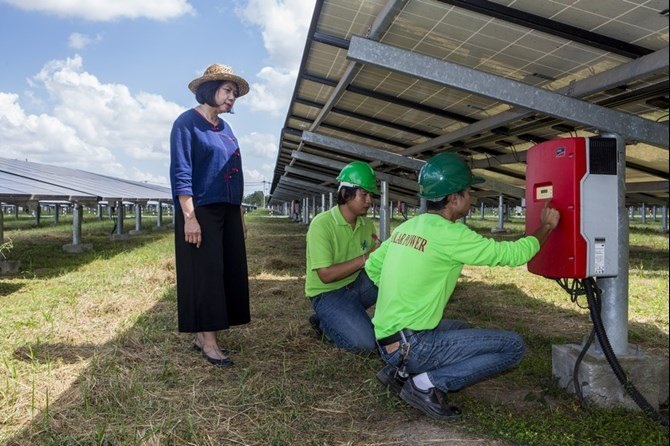
 Ms. Khunchornyakong monitoring some meters in one of her 36 solar fields in Thailand. Ms. Khunchornyakong monitoring some meters in one of her 36 solar fields in Thailand. As many people know, gender balance in the science and political world is nonexistent. Women have absolutely become more represented in these fields, but the disparity and difference between the genders is still there, and still strong. Along with science and politics, the COP becomes a melting pot for both of those worlds to come together as the climate science is applied and considered in policy making.
Along with more distinct and definitive wording needing to be utilized in the official policies, we also need to reconsider our entire approach to climate change. Think about it – when we hear about things like renewable energy, or new infrastructure, or more efficient appliances, or electric cars, what pops into everyone’s mind? Money. And why? Because politicians have made it that way. They’ve presented climate change not as the disaster it is, but as a component of the economy; of course, it influences and is influenced by the economy, but by no means does that mean can we put a price on human lives. So where does this tie into gender? Yesterday at the COP’s gender day, I had the wonderful experience of getting to listen to, amongst others, Wandee Khunchornyakong speak about how her company began. When she got permission from the government that she could create her solar farms, she went to the banks in her city, making the case in asking for loans. After almost every bank turned her down, Ms. Khunchornyakong was able to find a bank to cover 60% of the costs. Which meant she’d have to find 40%. At the talk, Ms. Khunchornyakong smiled out into the audience, reminiscing about these days, with her husband in the row directly behind mine. She looked out at us and said, “I told him, ‘if we lose, we only lose money. But if we win…’” The implications are there. If their solar farms were successful (which they are), they wouldn’t just earn money; but lower carbon dioxide emissions, and end up offering thousands of local jobs and opportunities for people. Ms. Khunchornyakong’s words, I think, embodied the difference between how women lead and how men lead. So far, the discussion has revolved around money, because as the saying goes, “money talks.” Well, I think money might talk too much. When we consider climate change, we always ask ourselves what we can do to change. What can we make more efficient? What habits are bad and make large, negative impacts? What alternatives do we have? Maybe we should begin to consider to change the leadership. Allowing women to rise up to higher positions, allowing them into the discussion for policy making and help design the roadmaps to a livable, sustainable future could completely change the discussion. In the Doha Climate Change Conference in 2012, they had written into the text of a policy that women needed to attain more leadership roles. If it was recognized then, why is it not clear now? This is one of the many reasons why climate change is not just an environmental issue; it is an issue that touches all aspects of life, including social issues, such as gender equality.
1 Comment
11/12/2014 04:51:06 am
Awesome article, it really made me think about how gender views the issues at hand. Leave a Reply. |
Categories
All
Archives
March 2024
|
 RSS Feed
Photo from Noel Feans
